
Spark exposes its own compiler as a surface for intervention
A Language Without a Name
Inside Catalyst1 there is a language for manipulating logical trees. It has a grammar, a composition mechanism, and execution semantics.
It is, in fact, an embedded DSL, but it isn’t documented as such and doesn’t have a name. Yet it’s the mechanism by which all of Spark’s analysis and optimization rules are written, from name resolution all the way to predicate pushdown. And it’s the same mechanism that Delta Lake, Iceberg, and other external projects use to extend Catalyst’s pipeline.
This article looks at Catalyst from that angle: not only as an optimizer, but as a programmable rewriting system.
The DSL
Catalyst’s pipeline is a sequence of rule batches, managed by RuleExecutor. Each batch has an execution strategy: Once or FixedPoint(n). A Once batch applies its rules a single time; a FixedPoint batch applies them all repeatedly until the plan stops changing or the maximum number of iterations is reached. The “stops changing” criterion is structural (fastEquals on the tree), not semantic: it’s a syntactic fixed point of the composed transformation function, not a guarantee of normal form, nor of confluence. What must stabilize is the composition of the batch’s rules, not each individual rule: per-rule idempotence is recommended engineering discipline (it prevents oscillation and rules producing structurally different but equivalent plans), not a formal API requirement.
The demo below applies a batch of rewrite rules to a small logical-plan tree until it stabilizes:
The demo uses a simplified top-down traversal. The point isn’t the traversal order itself, but the fixed-point execution of a batch of tree rewrites: what stabilizes is the composition of the rules, not any single rule on its own.
To give a concrete idea, two typical batches, reduced to their main rules:2
Batch "Operator Optimization before Inferring Filters" (FixedPoint)
  ├── PredicatePushdown
  ├── ConstantFolding
  ├── ColumnPruning
  └── SimplifyConditionals

Batch "Finish Analysis" (FixedPoint(1))
  ├── EliminateSubqueryAliases
  └── ReplaceExpressions
Each element of a batch is a Rule[LogicalPlan]: a function LogicalPlan => LogicalPlan that receives a tree, rewrites it, and returns it. It’s the unit of composition of the DSL.
Inside the Rule, the actual work is done by transform, a method of TreeNode[T], the abstract class from which all logical plans in Spark derive. In current Spark transform delegates to transformDown (preorder, parent before children), but the API explicitly warns rule authors not to rely on transform for directionality: when traversal order matters, use transformDown or transformUp directly. The rule applies a partial function where the pattern matches, and returns the transformed node. Where it doesn’t match, the node is left unchanged. The Rule[LogicalPlan] signature makes the transformation an endomorphism over LogicalPlan: it preserves Catalyst’s syntactic universe. Semantic invariants (resolution, types, exprId coherence) remain the rule author’s responsibility, not a framework guarantee.
In the following example the pattern captures a SubqueryAlias (the node that marks where a named subquery begins) and replaces it with the child subtree. After name resolution the alias is no longer needed, and this rule removes it from the tree. It’s one of the rules in the Finish Analysis batch shown above:
object EliminateSubqueryAliases extends Rule[LogicalPlan] {
  def apply(plan: LogicalPlan): LogicalPlan = plan transform {
    case SubqueryAlias(_, child) => child
  }
}
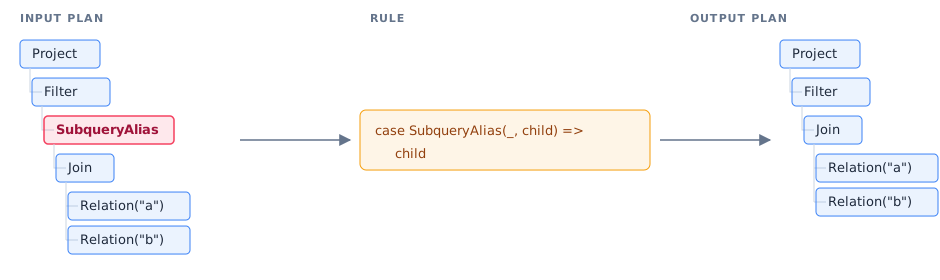
This is the language: case classes for the nodes, partial functions for the pattern matching, Rule for composition, RuleExecutor for execution. It isn’t complex, but it’s the computational structure on which the entire relational layer of Spark is built.3
How Spark uses the DSL internally
Spark uses this DSL uniformly across the logical-planning pipeline. Analyzer and Optimizer do different things, but they share the same machinery: both are built on RuleExecutor[LogicalPlan] and run batches of Rule[LogicalPlan].
LogicalPlan (unresolved)
       │
       ▼
   Analyzer  =  RuleExecutor
     ├── Batch "Substitution" (FixedPoint)
     ├── Batch "Hints"        (FixedPoint)
     └── Batch "Resolution"   (FixedPoint)
       │
       ▼
LogicalPlan (analyzed)
       │
       ▼
   Optimizer  =  RuleExecutor
     ├── Batch "Finish Analysis"       (FixedPoint(1))
     ├── Batch "Operator Optimization" (FixedPoint)
     └── Batch "Infer Filters"         (Once)
       │
       ▼
LogicalPlan (optimized)
       │
       ▼
   [physical planning, codegen — out of scope]
The operator-optimization phase contains rules such as predicate pushdown, column pruning, constant folding, boolean simplification, and filter combination.
The Analyzer performs name resolution, type coercion/checking, and attribute binding:
UnresolvedAttribute("age") → AttributeReference("age", IntegerType, exprId=42)
This transformation introduces exprId, a stable identity for resolved attributes. It disambiguates homonymous references produced by self-joins and aliasing. The analogy isn’t a classical symbol table name → declaration; it’s closer to the compiler technique of giving bound variables an internal identity, as GHC does with Unique on Var.
What matters here is less the what than the how: the transformation happens through rules over logical-plan trees. The same machinery that resolves UnresolvedAttribute is also used later by the optimization rules listed above.
The Optimizer applies these optimization rules. They too are expressed as Rule[LogicalPlan]:4
object PredicatePushdown extends Rule[LogicalPlan] {
  def apply(plan: LogicalPlan): LogicalPlan = plan transform {
    case Filter(condition, Join(left, right, joinType, joinCond, hint))
        if canPushToLeft(condition, left) =>
      Join(Filter(condition, left), right, joinType, joinCond, hint)
  }
}
Rule-based vs cost-based
Readers familiar with optimizer architecture can skip this section without losing the main thread.
This choice (rewriting by rules, rather than searching over a space of equivalent plans) isn’t a given. The main alternative, in relational optimizer architecture, is memo-based cost optimization5: these optimizers build a space of equivalent plans and use a cost model to choose a low-cost implementation. In that world, a rule is not merely an improving transformation. It can also express an equivalence, allowing the optimizer to explore combinations that no single rule would know how to produce directly.
This is more powerful in principle. In practice, it requires high-quality statistics, a memo structure to avoid combinatorial explosion, and a significantly more complex architecture. The central structural difference from Catalyst is the memo. Memo-based optimizers enumerate equivalent expressions in a shared structure and use cost to choose among them. Catalyst has no such memo:6 it applies directive transformations directly to the current tree.
Catalyst’s rule-based rewriting largely gives up global exploration in exchange for simplicity: a fixed sequence of local transformations, no general enumeration of alternatives, no global cost function selecting among them. The operational advantage is that every rule is readable and testable in isolation, and the set is extendable from outside without rewriting the optimizer: exactly the property Delta, Iceberg, and similar projects need. The disadvantage is fragility with respect to ordering: adding a rule can change the output plan in unexpected ways if it interacts with those that follow, and plan quality depends on what the active rules can recognize, not on the global optimum.
Spark’s cost-based join reorder is itself implemented as a Rule[LogicalPlan]: the mechanism remains rule-based; the difference is that the rule consumes statistics. The practical consequence is that performance in Spark often depends on what the optimizer can “see” structurally in the tree, not on the exploration of alternative plans. For common cases this matters little: Catalyst has a good set of normalization rules (CombineFilters merges adjacent filters, CollapseProject fuses consecutive projections, BooleanSimplification rewrites logical expressions) that make superficially different forms converge on the same optimized plan.
The difference emerges in complex plans: multi-way joins when cost-based join reordering is disabled or statistics are missing; physical-strategy selection in JoinSelection, which selects the first applicable physical strategy according to its priority order rather than keeping several alternatives alive for a later global cost decision; rule interactions blocked by correlated subqueries, CTEs, or UDFs that prevent local rewriting. The last is probably the most frequent case in practice. In all these cases two logically equivalent DataFrame transformation sequences can produce different physical plans: not because the optimizer is wrong, but because the shape of the input tree activates different rules.
A concrete example on Spark 4.1.1 (AQE and CBO disabled to isolate the rule-based pipeline): three datasets, A large, B very small (broadcastable), C medium (above the broadcast threshold). Two logically equivalent orderings:
val plan1 = A.join(B, "k").join(C, "k")   // (A ⋈ B) ⋈ C
val plan2 = A.join(C, "k").join(B, "k")   // (A ⋈ C) ⋈ B
Same final result (495 million rows in both cases). But not the same physical plan:
Form 1:                                  Form 2:
  SortMergeJoin                            BroadcastHashJoin
  ├── BroadcastHashJoin(A, B)              ├── SortMergeJoin(A, C)
  │   ├── A                                │   ├── Exchange + Sort(A)
  │   └── BroadcastExchange(B)             │   └── Exchange + Sort(C)
  └── Exchange + Sort(C)                   └── BroadcastExchange(B)
Form 1 broadcasts B first (a local operation, no shuffle of A) and pays the shuffle only for the sort-merge with C. Form 2 pays the full shuffle of A upfront for the sort-merge with C, and only afterwards applies the cheap broadcast of B. Same result, very different runtime cost. Spark doesn’t reorder because (without CBO and statistics) the JoinSelection strategy is applied to the two Join nodes in the order they appear in the tree: the first Join is mapped to the best of broadcast/sort-merge, and the second is evaluated on the output of the first, with its broadcast/sort-merge decision depending on the available size estimates for the resulting subtree. The alternatives (for instance: moving the broadcast of B to the top of the tree) aren’t even generated.
The examples/join_order_demo.scala script reproduces this comparison on Spark 4.1.1; the full output of the two explain calls shows every BroadcastExchange, Exchange, and Sort at the points predicted by the two orderings.
The example shows the rule-based pipeline’s sensitivity to logical tree shape; it doesn’t claim Spark can’t choose good joins in general: AQE can convert SortMergeJoin to BroadcastHashJoin at runtime, and explicit hints plus high-quality statistics with CBO enabled cover other cases. The point is isolated: with AQE and CBO disabled, what remains is the rule-based pipeline.
How external projects use the DSL
Spark exposes an API, SparkSessionExtensions,7 that allows external projects to inject custom rules into the Catalyst pipeline. It is a documented Developer API (marked @Experimental/@Unstable in Spark’s ScalaDoc), but it is the official extension mechanism Spark exposes for injecting parser, analyzer, optimizer, and planner customizations. The extension surface covers most of the planning pipeline, from parsing and analysis to optimization and physical planning:
injectParser: extend or replace the SQL parserinjectResolutionRule: add rules to the AnalyzerinjectPostHocResolutionRule: post-analysis resolution rulesinjectCheckRule: plan validation after analysisinjectOptimizerRule: add rules to the OptimizerinjectPlannerStrategy: physical-planning strategies
In current Spark versions, injected optimizer rules are integrated into the optimizer’s rule batches, including the operator-optimization phase. The exact placement is an implementation detail rather than a semantic contract: extensions should not depend on fine-grained neighboring order between external and native rules across Spark versions.
Delta Lake and Iceberg both use this mechanism, with different emphases: Delta intervenes mainly in parsing and analysis, Iceberg mainly in optimization, but there’s overlap: Iceberg also injects resolution rules, and Delta also injects optimizer rules.
Delta Lake injects a parser, analyzer rules, and check rules. It extends the analysis and validation portion of the pipeline:
// From DeltaSparkSessionExtension (simplified)
override def apply(extensions: SparkSessionExtensions): Unit = {
  extensions.injectParser { (session, parser) =>
    new DeltaSqlParser(parser)
  }
  extensions.injectResolutionRule { session =>
    new DeltaAnalysis(session)
  }
  extensions.injectCheckRule { session =>
    new DeltaUnsupportedOperationsCheck(session)
  }
  extensions.injectPostHocResolutionRule { session =>
    new PreprocessTableMerge(session.sessionState.conf)
  }
}
Iceberg injects rules into the optimizer. It extends the optimization portion:
// From IcebergSparkSessionExtensions (simplified)
override def apply(extensions: SparkSessionExtensions): Unit = {
  extensions.injectParser { case (_, parser) =>
    new IcebergSparkSqlExtensionsParser(parser)
  }
  extensions.injectResolutionRule { spark => ResolveProcedures(spark) }
  extensions.injectOptimizerRule { spark => RewriteDelete(spark) }
  extensions.injectOptimizerRule { _ =>
    OptimizeConditionsInRowLevelOperations
  }
}
The point of these snippets8 isn’t which rules they inject: it’s that external rules operate in the same pipeline, on the same types, with the same mechanism as native rules. A Rule[LogicalPlan] injected by Iceberg is structurally indistinguishable from PredicatePushdown.
A Static Analyzer on Catalyst’s IR
If projects like Delta Lake and Iceberg extend Catalyst for their own operations, the same mechanism is available to anyone. A concrete use case: an extension that intercepts dangerous patterns in the plan and signals, or blocks, them before execution.
A caveat: the code that follows is a sketch, not a production-ready library. The complete version lives at github.com/cdelmonte-zg/planguard.9
For an extension that inspects the plan and can reject queries, without transforming it, the correct hook is injectCheckRule. Unlike transformational rules, which are endomorphisms LogicalPlan => LogicalPlan, a check rule is a validator LogicalPlan => Unit: it inspects, it may throw, but it does not rewrite. It is invoked in the analysis check phase (not in the optimizer’s FixedPoint batches), so it isn’t multiplied by iterations the way an optimizer rule would be. It’s the documented point for analysis-level errors.
class PlanGuardExtension extends (SparkSessionExtensions => Unit) {
  // Entry point: Spark instantiates this class based on
  // spark.sql.extensions and calls apply once per SparkSession.
  override def apply(extensions: SparkSessionExtensions): Unit = {
    extensions.injectCheckRule { session =>
      DetectDangerousPatterns(session)
    }
  }
}
case class DetectDangerousPatterns(session: SparkSession)
  extends (LogicalPlan => Unit) with Logging {

  override def apply(plan: LogicalPlan): Unit = {
    plan.foreach {
      // 1. Inner join without a condition: the classic forgotten ON.
      //    df.crossJoin(other) is explicit user intent and is NOT
      //    intercepted (joinType = Cross, not Inner).
      case Join(_, _, Inner, None, _) =>
        throw new SparkException(
          "Join without condition detected: possible cartesian product"
        )

      // 2. Join with a condition but no equi-join key: the planner
      //    will fall back to BroadcastNestedLoopJoin / CartesianProduct.
      //    ExtractEquiJoinKeys is the same helper Catalyst uses to
      //    decide between hash and nested-loop.
      case j @ Join(_, _, _, Some(_), _) if !isEquiJoin(j) =>
        logWarning(
          "Non-equi join detected: will execute as nested-loop join"
        )

      // 3. Python UDF inside a Filter: an opaque node to Catalyst,
      //    blocks predicate pushdown and any rewrite on the predicate.
      case Filter(condition, _) if containsPythonUdf(condition) =>
        logWarning(
          "Python UDF in filter predicate: pushdown and optimization blocked"
        )

      // 4. collect_list / collect_set / collect_top_k in an aggregation:
      //    dangerous memory profile, non-spillable in-memory buffer.
      //    Note: in Spark 4.x Aggregate has 4 fields (groupingExpressions,
      //    aggregateExpressions, child, hint: Option[AggregateHint]);
      //    in 3.x there are 3.
      case Aggregate(_, aggregations, _, _)
          if aggregations.exists(containsCollect) =>
        logWarning(
          "collect_* in aggregation: may create large in-memory buffers"
        )

      case _ =>
    }
    // inspection-only: no return value, no plan transformation.
  }

  private def isEquiJoin(j: Join): Boolean =
    ExtractEquiJoinKeys.unapply(j).exists { case (_, leftKeys, _, _, _, _, _, _) =>
      leftKeys.nonEmpty
    }

  private def containsPythonUdf(expr: Expression): Boolean =
    expr.exists { case _: PythonUDF => true; case _ => false }

  // Collect[_] is the abstract parent class of CollectList, CollectSet,
  // and CollectTopK (all in org.apache.spark.sql.catalyst.expressions.aggregate).
  // CollectList/CollectSet are unbounded per group; CollectTopK is bounded by k
  // but can still be dangerous with large k or many groups.
  private def containsCollect(expr: Expression): Boolean =
    expr.exists {
      case AggregateExpression(_: Collect[_], _, _, _, _) => true
      case _ => false
    }
}
Registration:
spark.sql.extensions=dev.cdelmonte.planguard.PlanGuardExtension
Deployment doesn’t require modifying Spark: the extension is compiled into a JAR, included in the cluster’s classpath or passed via --jars at submit time, and activated with spark.sql.extensions=.... It’s the same procedure used, among others, by io.delta.sql.DeltaSparkSessionExtension in the delta-spark JAR.
spark.sql.extensions is additive: multiple values are comma-separated, for example io.delta.sql.DeltaSparkSessionExtension,dev.cdelmonte.planguard.PlanGuardExtension. In clusters with multiple extensions the value must be concatenated, not overwritten.
The same hook works “on the fly” from a programmatically constructed SparkSession, for example in a notebook or in PySpark:
spark = (
    SparkSession.builder
      .config("spark.sql.extensions",
              "dev.cdelmonte.planguard.PlanGuardExtension")
      .getOrCreate()
)
An operational detail worth noting: the JAR must be on the classpath when the JVM starts, not when the SparkSession is built. Concretely, it must be passed with --jars to spark-submit, or, from “pure” Python, via PYSPARK_SUBMIT_ARGS set before the pyspark import:
import os
os.environ["PYSPARK_SUBMIT_ARGS"] = (
    "--jars /abs/path/to/extension.jar pyspark-shell"
)
from pyspark.sql import SparkSession   # only from here on
This holds for any SparkSessionExtensions: it’s a property of the JVM bootstrap, not specific to this extension. In managed environments (Databricks attached cluster, EMR, Glue, Dataproc) the driver JVM is already running by the time getOrCreate is called: the classpath must be injected from the cluster configuration (init scripts, bootstrap actions, properties), not from code.
What the rule intercepts, and why at the logical-plan level
The cartesian join is intercepted at the logical-plan level, before the physical-strategy choice. AQE may demote a SortMergeJoin to SHJ/BHJ based on shuffle statistics, but it doesn’t convert a cartesian into something non-cartesian: the problem is structural, not resolvable at runtime. The rule distinguishes the intentional case (explicit crossJoin, joinType = Cross) from the accidental one (Inner with empty condition, the forgotten ON): only the latter is blocked.
The non-equi join is the cartesian’s less conspicuous cousin. The condition exists, syntactically it looks like a normal join, but no equality key can become a hash key: Catalyst cannot extract hash keys from it, so planning falls back to nested-loop or cartesian-like strategies such as BroadcastNestedLoopJoin or CartesianProductExec. The rule doesn’t block it (there are legitimate cases: range joins, semi-joins with < to select top-N); it simply makes it visible. For the check it uses the same ExtractEquiJoinKeys the planner consults to decide the physical strategy.
The Python UDF in a filter is an opaque node that blocks predicate pushdown. Catalyst can’t inspect its contents, so no rewrite rule can cross it. The rule doesn’t solve the problem: it makes it visible before the query runs on a cluster with real data.
collect_list in an aggregation isn’t a logical error: it’s an operational risk. No native Catalyst rule flags it. A traditional optimizer doesn’t worry about it; in a framework for distributed dataflow, the operational risk belongs precisely to the level where the plan is still inspectable.
PlanGuard is a static analyzer over Catalyst’s IR (a linter that enforces local operational invariants before execution), not an optimizer: it doesn’t pick a better plan; it rejects or flags plans that embody dangerous patterns.
Extending Observability
The same architectural position (a rule running at plan-time before execution) also works as a signal-emission point, not just a blocking one. Instead of just logging warnings or throwing exceptions, the Rule can emit OpenTelemetry spans or events, with metadata about the detected pattern, the plan involved, the problematic predicate. Cartesian joins and UDFs in filters are not only intercepted at plan-time: they’re tracked as events in the cluster’s monitoring system, through any OTel-compatible backend. Catalyst’s pipeline becomes an emission point for diagnostic signals, not just for plan transformation.
The hook is mechanical. You initialize a Tracer once. The OTLP exporter reads endpoint and service name from standard environment variables (OTEL_EXPORTER_OTLP_ENDPOINT, OTEL_SERVICE_NAME):
// lazy val: the SDK starts on first detection, not at class-load.
// Standard OTel env vars decide where and how to export.
private lazy val tracer: Tracer = {
  val provider = SdkTracerProvider.builder()
    .addSpanProcessor(
      BatchSpanProcessor.builder(OtlpGrpcSpanExporter.builder().build()).build())
    .build()
  // Without a shutdown hook BatchSpanProcessor loses queued spans
  // when the JVM terminates: the worst case for blocking events.
  Runtime.getRuntime.addShutdownHook(new Thread(() => provider.close()))
  OpenTelemetrySdk.builder().setTracerProvider(provider).build()
    .getTracer("dev.cdelmonte.planguard")
}
Each detection becomes a span with attributes10 about the pattern and the node. The span is opened and closed in-place inside the case branch: the plan isn’t touched, only observed. It’s a zero-duration span: used as an event (a counter source via spanmetrics), not as a unit of time. The canonical OTel path for a pure counter is the Meter API; the span-as-event is a conscious alternative, because a single emission yields both the per-query detail and the aggregated metric without duplicating the source. On Tempo or Jaeger it will appear disconnected from the Spark query trace, which is exactly what we want.
case Filter(condition, _) if containsPythonUdf(condition) =>
  tracer.spanBuilder("catalyst.plan_guard.detect")
    .setAllAttributes(Attributes.of(
      AttributeKey.stringKey("planguard.pattern"), "python_udf_in_filter",
      AttributeKey.stringKey("planguard.node"),    "Filter"))
    .startSpan().end()
  logWarning("Python UDF in filter predicate: pushdown blocked")
From here on the pipeline is the standard OTel one: the span travels in OTLP gRPC to the collector, can be exported to any backend, and (through the spanmetrics connector) is automatically converted into a Prometheus counter. A single emission produces both the detail for diagnosis (the individual query, the plan, the attributes) and the aggregated metric for alerting. Catalyst’s DSL doesn’t just rewrite the plan: it’s also the point at which the plan becomes visible.
Conclusions
Catalyst isn’t just Spark’s internal optimizer. It’s a framework with an embedded DSL for manipulating logical trees, and that DSL is one of the system’s main programmable surfaces at the query-planning level: the one in which the dataflow is still represented as a transformable structure, before it becomes physical code.
Logical-plan analysis and optimization are built on a single mechanism: rules that pattern-match on tree nodes and rewrite them. The same mechanism is exposed externally through SparkSessionExtensions, and it’s the same mechanism by which Delta Lake extends the analyzer and Iceberg rewrites operations in the optimizer. Anyone can inspect, transform, or reject a dataflow before it is executed.
Most Spark users will never see this DSL. But it is the level at which Spark analyzes, optimizes, and prepares every query for physical planning. The actual code generation to JVM bytecode happens downstream, in WholeStageCodeGen. Once you’ve seen this level, Spark no longer appears as just an engine that runs distributed transformations, but as a system that exposes its own compiler as a surface for intervention.
The operational pitfalls one encounters writing real rules are the subject of the article Anti-patterns in Catalyst rules, the operational counterpart to this one.
Notes
-
Armbrust et al., Spark SQL: Relational Data Processing in Spark, SIGMOD 2015: the foundational Catalyst paper, with the architectural motivation for rule-based rewriting. Source code lives in
org.apache.spark.sql.catalyst.{trees, rules, plans}:TreeNode,Rule,RuleExecutor,LogicalPlanand the cited rules (EliminateSubqueryAliases,PushDownPredicates, referred to asPredicatePushdownin the text,BooleanSimplification). ↩︎ -
A note in the spirit of philological honesty: in the Spark source
Finish Analysisis a batch with a single meta-rule (FinishAnalysisinOptimizer.scala) that internallyfoldLeft-applies a set of sub-rules, includingEliminateSubqueryAliasesandReplaceExpressions. The diagram above is didactic. ↩︎ -
For those familiar with functional compilers: this structure (iterative rewriting over term trees until stabilization) resembles the way GHC organizes its simplifier passes over Core (Santos & Peyton Jones, “A Transformation-Based Optimiser for Haskell”, Science of Computer Programming 32, 1998). Catalyst splits the rewriting across two ADTs (
LogicalPlanfor relational nodes,Expressionfor predicates and functions), while GHC operates on a single Core ADT. Same mechanism, different domain. ↩︎ -
The snippet is intentionally simplified. The real rule (
PushDownPredicates) splits conjunctive predicates (Filter(a AND b)is broken apart and each conjunct is pushed independently), and also accounts for join type, aliases, determinism, and many other constraints. ↩︎ -
Memo-based optimizers populate a shared structure with equivalent expressions and use cost estimation to select the cheapest physical implementation. The canonical pedigree is the Volcano Optimizer Generator (Graefe & McKenna, ICDE 1993) and its successor Cascades (Graefe, 1995), alongside IBM’s Starburst (Lohman, Pirahesh et al., late ’80s), with evolutions in SQL Server (Cascades-derived) and Postgres (System-R / dynamic-programming lineage). ↩︎
-
“Memo” here means a Cascades-style shared structure of equivalent sub-plans during search. Spark’s
CacheManageris a separate mechanism that caches query results (data) keyed by structural plan equivalence; it isn’t a memo of equivalent sub-plans available for cost-based selection during planning. ↩︎ -
SparkSessionExtensions ScalaDoc: the documented Developer API for the extension point. ↩︎
-
The snippets above are simplified and version-dependent: the exact set of injected rules changes across Delta and Iceberg releases. ↩︎
-
The operational pitfalls (placement, idempotence,
FixedPointmultiplication, PySpark bootstrap) are covered in Anti-patterns in Catalyst rules, the operational counterpart to this article. ↩︎ -
Attributes must stay low-cardinality. Embedding the full plan, raw predicates, or a per-query
query_idwill blow up the cardinality ofspanmetrics-derived metrics; a plan fingerprint (a hash) is safer. ↩︎